My New Roommate
[/caption]
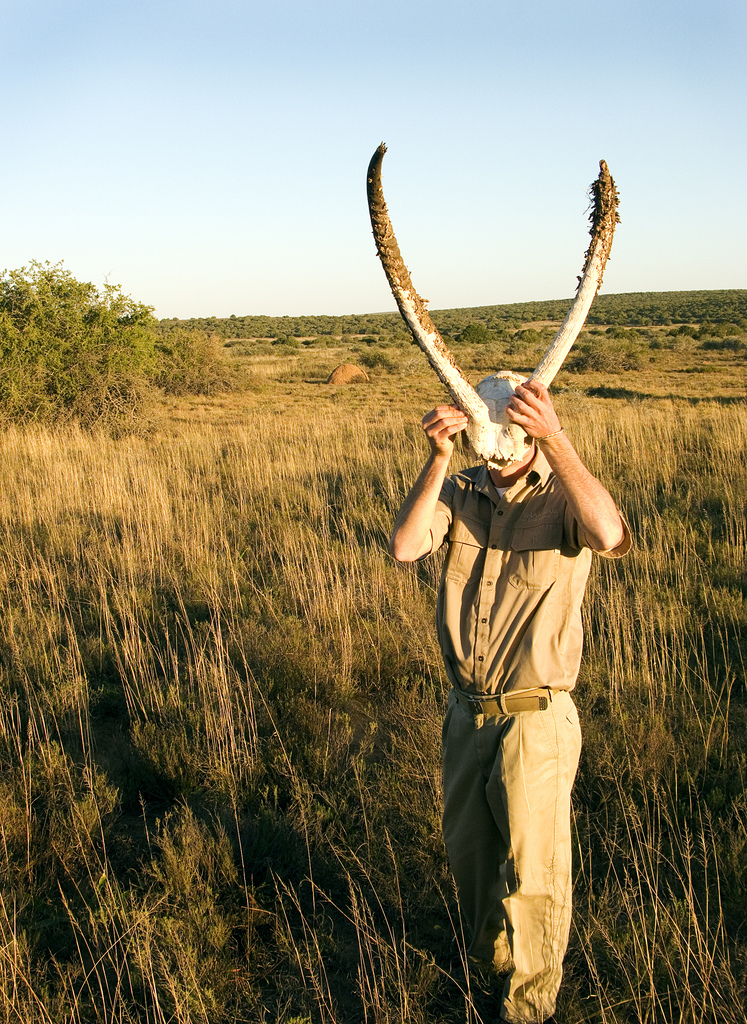
I am pleased to report that Dr. Emma Rodríguez Suárez has moved in with me.
[/caption]
I am pleased to report that Dr. Emma Rodríguez Suárez has moved in with me.
[/caption]
Staying in Saint Johns Wood, London, this week, I realized I was only a few blocks from the legendary Abbey Road Music Studios, so I made a pilgrimage.
Sir Edward Elgar, Cliff Richard, the Zombies, Hollies, U2, The Red Hot Chili Peppers have recorded there. But what made it most famous was the Beatles recorded all their albums there and Pink Floyd recorded all of its major albums there. Although the Beatles released their Let It Be album later, their last recorded album was named Abbey Road and its cover photo [inset] made the pedestrian crossing in front of the studios famous.
Unlike Iain MacMillan, who in took the cover photo on 8 August, 1969, I couldn’t stand in the middle of Abbey Road due to heavy traffic. So I took the reverse shot (standing next to the nearby taxi stand you can see between Ringo Starr’s and John Lennon’s heads in the albumn cover).
There’s also a Web cam looking at the crossing.
In addition to popular music albums, Abbey Road Music Studios was where the musical scores for the Star Wars, Indiana Jones, Harry Potter, Lord of the Rings, and dozen of other films were recorded. Orchestral musicians were arriving for work while I was photographing.
Am in London this week to give the opening keynote at EPublishing Innovations 2008. Despite the 2008 in that title, it's a new conference with a limited initial budget. Despite its being held at the Marriott Regency Park Hotel, they've booked me into the Hotel Danubius. Both hotels are in St. Johns Woods and reasonably near each other (ten minute walk or a four minute taxi ride). Moreover, the Danubius is across the street from the London Central Mosque and one block from Regents Park itself (the Marriott is some ten blocks from the park) and from Winfield House, home of the U.S. Ambassador
As I suspected from its name, however, the Hotel Danubius isn’t a Anglo-Saxon hotel. Its the only hotel in the United Kingdom operated by a Hungarian hotel chain. So, what does one do when one stays in a Hungarian hotel in London?
Well, when in a Roman hotel, eat Roman. Sure enough, the restaurant in the Hotel Danubius is great at Hungarian food but only average at English dishes. So, I’ve spent several days eating great goulash in the hotel and walking outside it amid veiled Islamic women who are accompanied by Islamic men smoking water pipers at the cafe across the street from the mosque. Welcome to this block of London town!
Many of the Americans I’ve met who’ve never traveled outside the 50 States are so gullible that they believe the French are — as the Simpson animated TV show once said — ‘Cheese-Eating, Surrender Monkeys‘. But the time I’ve spent climbing with French guides in the Alps or watching French extreme skiers descend those peaks has led me to admire how courageous they can be. Sometimes crazily so!
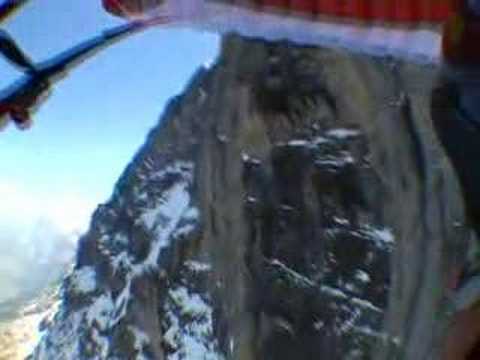
Above is an example, a short video that won the ADVENTURA award for best short extreme film at the international adventure film festival of Montreal last year. The 3-minute 15-second clip, shot from his helmet camera, shows François Bon’s 5,000-foot ‘speedflying’ (skiing with a parachute) descent from the summit of the Eiger on June 16, 2006.
I began working full-time in the new medium on December 7, 1993, when I took a job at Delphi Internet Services Corporation in Cambridge, Massachusetts. That was 5,000 days ago.
On that day, Rupert Murdoch’s News Corp. bought tiny Delphi. He wanted to start a major online service, much as he had recently purchased television stations and started the Fox television network, and he needed a core of expertise about online to do this. On that December 7th, he used a tactic that old media company traditionally use whenever they don’t understand something into which they want to venture: they purchase expertise outright and hope the knowledge and skills of that expertise will be absorbed by osmosis throughout their company. A corporate tactic that I call We Will Become What We Eat.
On that day, Delphi had approximately 37,000 subscribers. Yet this was in the early days of online, when CompuServe had 2 million subscribers; Prodigy 700,000; America Online 125,000; GEnie 100,000; Interchange less than ten thousand; and no more than a total of 6 million people worldwide had online access. Why didn’t Murdoch purchase a larger online service than Delphi? The size of what he purchased didn’t matter to him; after all, he’d formed the Fox Network from tiny UHF television stations. Furthermore, Delphi was his only choice because it was the only online service that wasn’t already owned by a large corporation. H. & R. Block owned CompuServe, IBM and Sears owned Prodigy, General Electric owned GEnie, Ziff Communications and later AT&T owned Interchange, and Quantum Computer Services had renamed itself American Online and become a publicly-traded company in its own right.
Moreover, Delphi had a latent asset that we can only now appreciate in retrospect. On that day in 1993, only one other company worldwide was supplying Internet access to consumers: even smaller Worldnet, a few blocks away in Cambridge. These two tiny companies were the only consumer Internet Service Providers in the world. Knowing what we know today about the popularity of Internet access, do you think that News Corp.’s failure to utilize its ownership of what was then the world’s largest ISP (one of only two ISPs in the world) is perhaps the greatest lost opportunity by a company in new-media? I certainly do.
But the world was different on that windy and partly overcast day on Porter Square, down from in Harvard Square in Cambridge. The world has changed a lot in 5,000 days. Yet there hasn’t been a single day since on which I’ve regretted leaving old media. I can now confidently state that the new medium is replacing the old. Five thousand days after December 7, 1993, please allow me to say what I’ve seen and restate why I am in this business.
I’ve not seen the up and down phases of the Internet bust and boom that the popular and trade press are fond of seeing since 1993. What I’ve seen is a straight line continually rising. The ups and downs, booms and busts, and other gyrations were investors’ and traditional media companies’ helical movements rotating around that upward line. When in 2000 investors lost their shirts in the Internet bust and quite a few traditional media company executives were saying, ‘I told you this online thing was just a fad,’ consumers’ use of that ‘online thing’ was rising as steadily as it had during the Internet boom, no matter if investors had lost shirts and wingtips.
Nonetheless, it’s fun arbitrarily categorize things. I could categorize the skyrocket of online as having had four stages during the past 5,000 days.
When historians in the future look back at the 21st Century, the historical theme they will see is Tribalism versus World Law.
During the previous century, not only were all the ‘terra incognitas’ on the world’s maps eliminated but the nations and peoples of the world became interdependent, thanks to modern technology and modern transportation. ‘Globalization’ is only one aspect of that change. Viruses and plagues can now be transmitted worldwide in a matter of days. Pollution in any one country affects other or all countries. Etcetera.
Whether or not the nations and peoples of the world have the wisdom to cooperate and solve or prevent problems is the big question. Will nations and peoples revert to tribalism (ethnic cleansing, unilateral actions, etc.) or will they work together?
Via Flickr.com, I’ve discovered the remarkable ‘clone’ self-portraiture of Natalie Aniela Dybisz of Brighton, England. Great photography and use of Photoshop. Go see her work.

American media is fascinated with large breasts? Has it always been that way? It seems to predate Hugh Hefner‘s founding of Playboy magazine in the 1950s or Howard Hughes‘ mammary engineering of Jane Russell in the 1943 film The Outlaw. I think it might have started with the Gibson girls at the beginning of the Twentieth Century.
Though Americans of both genders probably appreciated large breasts before that, the feminine idea (i.e., figure) had been much less top-heavily. Though the French revolutionary symbol of Liberty, Marianne, shows the contents of her C-cups whiling the people over the barricades, most depictions of women prior to the Twentieth Century, notably females in classical Greek and Roman sculptures and medieval and Renaissance art, featured neither wasp waists nor C- or D-cups. In fact, the concept of bra cup sizes is a Twentieth Century American invention, as is the brassiere or ‘bra’ itself. And, after all, everything is big in America.
So forgive 21 year-old British actress Keira Knightley‘s surprise to discover her images in the pictures and posters promoting her films in the U.S. have digitally enhanced her breasts. (Click the picture above to, er, enlarge). According to the Daily Mail of London, Knightley claims that American magazines ban stars from appearing on their front covers unless they have at least a C-cup size, or are willing to be digitally enhanced to make it appear as if they have.
If true — and, from being around the U.S. magazine industry for years, I suspect it is true — then it’s too bad, because Ms. Knightley has beautiful breasts that don’t need enhancement. Any fan of the young Charlotte Rampling (or even young Michelle Pfieffer in the film Scarface) knows that.
A- and B-cup breasts don’t need enhancements but display, or more realistically the tantilization of near display. Like a present that’s partially but not yet identifiable unwrapped, a woman with A- or B-cup breasts who keeps an extra button or two open atop her blouse is far more tantilizing to men than a woman her displays C- or D-cup cleavage. We men like to know what we’re about to get more than what we’ve already got.

I returned Sunday from two weeks in Singapore and Malaysia. My round-trip was on the world’s longest commercial airline route: Singapore Airlines’ Non-stop flights between Newark and Singapore. Each 15,349-kilometer (9,593-mile) flight takes between 18 and 20 hours, depending upon weather conditions. The airline uses a four-engine Airbus 340-500 with 181 (rather than the standard Airbus 340’s 300) seats.
My flights took 18 and 18 and a half hours each, and used different routes. The flight from Newark headed directly north over the pole and then directly south over Siberia, Mongolia, China, Thailand, and Malaysia. However, my return flight followed a more traditional airline route between Asia and North America: Over the South China Sea, over the Pacific off the coasts of Taiwan, Japan, and Siberia, then over Alaska and diagonally across Canada. I don’t know whether the return took that route to lessen the amount of overflight fees that Singapore Airlines has to pay various countries or else because it takes less time due to prevailing trade winds.
Either way, 18+ hours aboard an airliner didn’t feel much different than 8 hours aboard an airliner (but must for the pilots). It was much better than changing plans in Seattle, San Francisco, Los Angeles, Tokyo, Seoul, Shanghai, Hong Kong, Manila, or Bangkok. I generally go out of my way (in this case Newark airport) to fly Singapore Airlines. Its service, as usual, was superb.
Parkour is the new, urban, extreme sport of elegantly and efficiently overcoming obstances.This sport combines gymnastics and a tenacious flow along a course. Think of how Hong Kong martial arts star Jackie Chan chases someone through industrial or urban environments. According to Wikipedia::
Parkour is an art form of human movement, focusing on uninterrupted, efficient forward motion over, under, around and through obstacles (both man-made and natural) in one’s environment. Such movement may come in the form of running, jumping, climbing and other more complex techniques. The goal of practicing parkour is to be able to adapt one’s movement to any given scenario so that any obstacle can be overcome with the human body’s abilities.
The sport was largely invented by Frenchmen David Belle and Sebastien Foucan. Participants attempt to pass obstacles in the fastest and most direct manner possible, using skills such as jumping and climbing, or the more specific parkour moves. The name parkour derives from the (identically pronounced) French word parcours, meaning course. Participants are called traceurs, a French word meaning bullets, for their speed and directness.
For some video examples of parkour, see or Parkour.net or Focaun’s Parkour.com. A parkour sequence opens the forthcoming James Bond movie Casino Royale. Foucan plays a villian chasing Bond.

Europe continues to turn into a European historical theme park. Whenever I visit Britain, I’m surprised by how much that country devotes itself to being a historical park for tourists.
France is no different, and the latest evidence is a story in today’s The New York Times about how the government officials who operate the Palace of Versailles are timing new exhibits there to coincide with American film director Sofia Coppola‘s movie Marie Antoinette.
Meanwhile, the Louvre has been similarly milking American director Ron Howard film The Da Vinci Code, which was the first commercial film that the French government ever permitted to film within that museum. Though Versaille and the Louvre are devoted to accuracy, French critics point out numerous historical inaccuracies in the Coppola film plus the fact that the Howard film is complete fiction. But officials just give a Gallic shrug; the films have been good for those historic places’ box offices. (The photo above isn’t actually from the Coppola film, but is Madonna portraying Marie Antoinette. Hye, what better example can I give? Click to enlarge it)
Wouldn’t Britain and France be better devoting themselves to future glories, rather than those of the past? To producing the future, rather than the past?
I dunno? In this Information Age, maybe the past is the information that these countries are producing.