Vin Crosbie's Personal Blog

For his business blog, visit http://www.digitaldeliverance.com

The Hallmark Flaw of the Mass Media

Ask historians to say when the Industrial Era began and they will cite dates in the 18th or 19th centuries when a factory powered by hydraulics or steam engine was first constructed in their nation. I think they’re wrong. The start of the Industrial Era shouldn’t be defined by what powered mechanisms of mass production, but by the invention of such a mechanism itself. In approximately 1454, the entrepreneurial metallurgist Johannes Gutenberg invented the moveable type printing press: the world’s first mass production device. Prior to Gutenberg, books were rarities, affordable only by the church or the rich. A typical scribe or monk in a scriptorium could copy by hand two to four pages daily, laboriously producing a simple book in three to six months. If the book was also ‘illuminated’ with illustrations or decorations, it could take up to three years. Gutenberg’s press used metal type characters that were set in a mirror-image analog of the page to be printed. This was then inked and pressed onto paper. A two-man team operating the press lever or crank could imprint hundreds of pages daily, enough to produce hundreds of books per month, more than a lifetime’s production by a scribe or monk. The societal effects of Gutenberg’s press are often cited as ending the Middle Ages and beginning the Modern Era. This first mass production device fundamentally improved how human beings distribute, store, and trust information. Nearly half a millennium later, Guglielmo Marconi’s invention of wireless broadcasting markedly extended the immediacy and reach of information. He converted electrical teletype signals into analog electromagnetic waves of radiation that could be instantly received across huge distances. The later additions of microphones and photovoltaic sensors and cathode receiver tubes resulted in radio and television. From these analog production and distribution technologies of the Industrial Era arose the theories, doctrines, business models, products, services, and practices that are now colloquially known as the Mass Media. Their industries globally generate US$3 trillion in gross revenues annually. The Present Since the mid-1990s, the Mass Media industries have created online versions of their Industrial Era products and services ‘converged’ into multimedia websites or ‘streaming’ services. The industries hoped that consumers and advertisers would utilize the websites the same way (i.e., as often and thoroughly) as consumers had printed products or broadcast services during the 20th Century. The industries hoped that the same Industrial Era business models would […]

Bezos & Bogeymen

Don’t Get Distracted from the Existential Problem In 1998 when I first began questioning if the Mass Media industries would have a future, the senior vice president of marketing at largest daily newspaper in Texas tried to reassure me, “People have been using newspapers for centuries, so we expect they will for centuries more.” What immediately crossed my mind was that horses had been a prime means of transportation for millennia, so people living 100 years ago probably thought this meant that horses would still be a prime means of transportation in future centuries, too. How wrong they were! Within 30 years of 1898, horses had disappeared as a prime means of transportation in most developed nations. Not just in Texas! Last week in this newsletter’s first edition, I stated that its focus is the existential threat now confronting the Mass Media industries as the Industrial Era wanes and the Informational Era dawns. What is this threat? Is it truly existential? Or am I being over-dramatic or otherwise hyperbolic? No, I can justify what I here state. Twenty years ago, the Mass Media industries was riding high. Many of those industries announced recorded earnings during the first half-decade of the new millennium. Although the ‘Great Recession’ then struck, those industries reasonably expected to restore and resume those record earnings soon afterward. However, that didn’t happen. Since 2007, almost all sectors of the Mass Media industries have seen plummeting audiences (i.e,. readership, listenership, or viewership); advertising clienteles; and gross revenues (turnover) when such numbers are adjusted for population growth or inflation. Some of the declines have been spectacular, an example of which I’ll describe below and in subsequent newsletters. Starting next week, I’ll likewise write about he categorical reasons for these declines. However, in this second edition of the Digital Deliverance newsletters, let’s focus on the proximate reason why the Mass Media industries are not only in rapid decline but actually in danger of extinction, a tangible problem already creating troubling societal effects. What is this existential threat? Some myopic pundits call it the ‘Missing Business Model’ problem. During the past 30 years, literally billions of consumers worldwide have begun using personal computer-mediated technologies, rather than printed products or broadcast services, as their primary means of obtaining news, entertainment, and other information. Yet during that time, the Mass Media industries unfortunately haven’t been unable to devise a business model or models […]

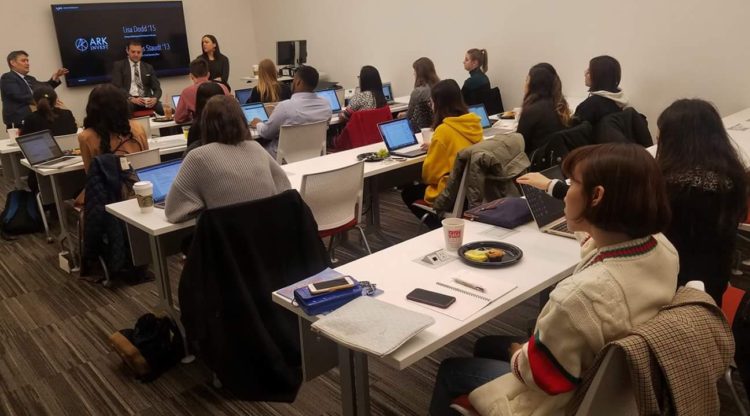
18 Alumni Instructing 18 Students

This week I’m in New York City sitting-in on a 39-hour (nearly non-stop for five-business days) course in which 18 alumni of my New Media Management master’s degree program at Syracuse University will teach 18 of my current students in the program. The 18 instructors this year from among the program’s more than 200 alumni: Edward Alcide, graduated in ’13, Media Manager, 605; Dylan Beyer, ’12, Brand Manager, Whiskey Division, Proximo Spirits; Robert Bierman, ’16, SVP, CBInsights, Founder Tiny World Media Brittany Campbell, ’10, Global Business Development Partnerships, Google; Ashley Christiano, ’11, Senior Marketing Manager, Reuters TV; Nick Cicero, ’10, CEO, Delmondo; Bethany Devendorf, ’12, Sales Engineer, GeoEdge; Lisa Dodd, ’15, Strategic Marketing and Development Manager ARK Investment Management; Andrea Jacob, Syracuse ‘10, Manager Business Operations, Viacom; Rania Kouadjia, ’16, Digital Account Manager, Complex Networks; Jennifer Krist, ’15, SEO Analyst, 2U; Nathan McAlone, ’15, Entertainment Editor, Business Insider; Edward W. McLaughlin, ’12 Manager, Integrated Planning, UM Worldwide; Lisa Scheinman, ’12, Product Manager, SIMMONS Research; Tom Staudt, ’13, President, ARK ETF Trust / Chief Operating Officer ARK Investments (a +$4 billion fund); Meghavaty Suresh, ’15, Director, Consumer Strategy, Guardian News & Media; Xiaowei Wang, ’15, Manager, Automated Solution, PadSquad; Sydney Yarnell, ’14, Digital Marketing Analyst, Stony Brook University; Shuai (Suya) Wang, ’14, Principal & Co-Founder, WestOeast (Toronto); If you’re one of my many Facebook friends in the media business whose company seeks talented holders of postgraduate degrees in New Media Management (a fully-accredited dual New Media/Business master’s degree from a major university), you won’t find that talent from schools. Contact Steve Masiclat or me.

27 Years in the News Business

Ah, I’m entering my 27th year in the news industry. I started as a reporter covering cops, fires, and courts for a small daily newspaper in Connecticut. Later, I worked for the old UPI, Reuters, and News Corp. My thanks to Prof. Ben Compaine who at the start of the 1980s interested me in the potential of new media and to venture capitalist Jon Gilbert who in 1993 brought me into new media full-time. I’ve never regretted that move. (By the way, I don’t think the Connecticut State Police really minded that I didn’t return my police pass after 1979 ended. Indeed, I felt it odd being nearly invulnerable to speeding and other motor vehicle infractions during those years. The police departments of many towns and state police barracks knew my auto and wouldn’t stop it in speed traps. Only once was I pulled over, when I was late for work and driving 85 m.p.h. on a 45 m.p.h. rural road. The officer, rather than asking me for my driver’s license and vehicle registration, said , “Has anyone told you the problem we in the police union are having with management?” and gave me a story. Oh, to be a police reporter again!)